Cornwall's landscape tells a story of extraordinary human ambition. For centuries, engineers, miners and builders pushed the boundaries of what was possible, leaving behind a legacy of structures that are as visually striking as they are technically remarkable. From the granite viaducts that span deep valleys to the engine houses that cling to sea cliffs, these are places where you can stand in awe of what people achieved with wrought iron, steam power and sheer determination.
What makes Cornwall's engineering heritage particularly special is how dramatically it sits within the natural landscape. Engine houses perch on cliff edges above crashing waves. Viaducts stride across wooded valleys. A railway bridge frames the Tamar estuary. These are not relics hidden away in museums -- they are woven into the scenery, and many are still in active use today.
Royal Albert Bridge, Saltash
Isambard Kingdom Brunel's final masterpiece, the Royal Albert Bridge, spans the River Tamar at Saltash, connecting Cornwall to Devon by rail since 1859. The bridge is an engineering landmark of the first order: two massive lenticular trusses, each 455 feet (138.7 metres) long, carry the railway 30 metres above the high-water mark. Brunel's innovative design combined a tubular arch with a suspension chain in a form never attempted at this scale before.
The bridge is Grade I listed and, remarkably, still carries the main line railway into Cornwall more than 160 years after it opened. Brunel's name is inscribed in giant letters on each portal -- added as a memorial after his death in September 1859, just months after the bridge's completion. It was the last major project he saw finished.
The best viewing points are from the Saltash waterfront or from the modern Tamar road bridge alongside it. You can also cross the bridge by train on the Plymouth to Penzance line, which offers a memorable experience as the train passes through Brunel's portal and over the water.
Wheal Coates Mine, St Agnes
Few images capture Cornwall's mining heritage more powerfully than the Towanroath engine house at Wheal Coates, standing alone on the clifftop above Chapel Porth beach. The mine operated from 1802 to 1889, extracting tin from shafts that ran beneath the Atlantic. Today the engine house ruins are part of the UNESCO World Heritage Cornwall and West Devon Mining Landscape.
The site is managed by the National Trust with free access at all times. A short walk from the car park at Chapel Porth (National Trust, parking charges apply) takes you along the cliff path to the engine house. The setting is extraordinary -- rugged coastline, crashing surf below, and the stark silhouette of the engine house against the sky. It is one of the most photographed spots in Cornwall for good reason.
Levant Mine and Beam Engine, Pendeen
At Levant, the National Trust has preserved the oldest working Cornish steam winding engine still in its original location anywhere in the world, a piece of machinery that once hauled ore from shafts extending far out beneath the seabed. The mine operated from 1820 to 1930, and the restored beam engine, dating from 1840, is steamed on regular open days throughout the summer season.
Watching the beam engine in motion is a visceral experience. The slow, deliberate stroke of the beam, the hiss of steam, the mechanical precision of the linkages -- it brings the industrial past to life in a way that static displays cannot. The engine house sits on the cliff edge near Pendeen, and the surrounding landscape of mine workings, shafts and spoil heaps is part of the UNESCO World Heritage Site. Admission is charged for the beam engine; check the National Trust website for steaming days.
Geevor Tin Mine, Pendeen
Just along the coast from Levant, Geevor is Cornwall's largest preserved mine site, covering 67 acres. The mine produced tin from 1911 until its closure in 1990, and today it operates as a comprehensive museum that gives visitors a thorough understanding of what tin mining actually involved.
The highlights include an underground tour through 18th-century tunnels (hard hats provided), the mill where ore was processed, and extensive mineral displays. The site is well presented and genuinely absorbing -- allow at least two to three hours. Geevor is located at Pendeen, TR19 7EW, with on-site parking. It is open most of the year but has seasonal variations, so check ahead. Admission is charged.
Botallack Mine
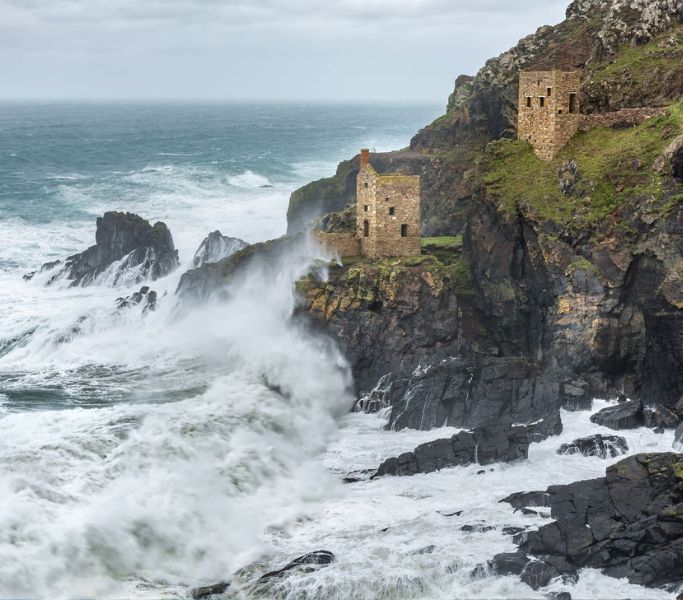
The crown engine houses at Botallack are among the most dramatically sited industrial buildings in Britain. Two engine houses cling to the cliff face, one above the other, looking as though a single storm might sweep them into the sea. The mines beneath ran out under the ocean floor, and contemporary accounts describe miners working in tunnels where they could hear boulders rolling on the seabed above them.
Botallack gained wider fame as a filming location for the BBC's Poldark series, and the site draws visitors who recognise the engine houses from the screen. The National Trust manages the site with free access to the cliff paths. The walk down to the crown engine houses is steep and can be slippery, so wear appropriate footwear. The views along the coast in either direction are superb.
East Pool Mine
If Levant has Cornwall's oldest working beam engine, East Pool has one of the largest. Harvey's 90-inch beam engine is a colossal piece of Victorian engineering, with a cylinder 90 inches in diameter that once pumped water from the deep mine workings. It is one of the largest surviving Cornish beam engines anywhere.
The National Trust runs the site with regular engine demonstrations. A second, smaller engine -- the 30-inch whim engine used for winding -- is also preserved on site. East Pool sits between Redruth and Camborne, in the heart of Cornwall's mining district, and makes a good complement to a visit to the coastal mines further west. Admission is charged.
Treffry Viaduct, Luxulyan Valley
Hidden in the beautiful wooded Luxulyan Valley, the Treffry Viaduct is a structure of quiet magnificence. Built between 1839 and 1842, with the tramway on top completed by 1844 by the local industrialist Joseph Treffry, it served a dual purpose: a railway viaduct carrying mineral tramways on top and an aqueduct channelling water through a leat within its structure. This ingenious combination of functions in a single piece of infrastructure was ahead of its time.
The viaduct stands 30 metres (98 feet) high and stretches 200 metres across the valley on ten granite arches. It is a Scheduled Monument and forms a striking centrepiece to the Luxulyan Valley, which is itself a World Heritage Site. The valley is accessible on foot via well-marked trails from Luxulyan village, and the walk through the wooded valley floor to the base of the viaduct is lovely at any time of year. Access is free.
Calstock Viaduct
Spanning the Tamar Valley on twelve elegant arches, Calstock Viaduct was built between 1904 and 1907 using a technique that was groundbreaking at the time. Rather than constructing the arches from traditional masonry, engineers used 11,148 precast concrete blocks, each cast on site and lifted into position. The viaduct rises 37 metres above the river and is still in daily use on the Tamar Valley Line between Plymouth and Gunnislake.
The best way to appreciate Calstock Viaduct is to arrive by train: the line crosses high above the village and the river, offering panoramic views of the valley. Alternatively, the village quayside below provides a fine vantage point looking up at the arches. The Tamar Valley Line is a scenic journey in its own right and worth taking for the views alone.
Lizard Lighthouse, Lizard Point
The lighthouse at Lizard Point has guided ships past Britain's most southerly headland since 1619, making it one of the oldest lighthouse sites in England, with a light first exhibited here in 1619. The current tower dates from 1752 with later modifications, and the light was automated in 1998. Today the Lizard Lighthouse Heritage Centre is open to visitors, offering tours of the tower and exhibitions on the history of lighthouse keeping and maritime safety.
The setting on the tip of the Lizard Peninsula is dramatic, with sweeping views along the coastline. The Heritage Centre is open seasonally, and there is a car park nearby (charges apply). Combine a visit with a walk along the coast path in either direction for some of Cornwall's finest coastal scenery.
Longships Lighthouse
Visible from Land's End, the Longships Lighthouse stands on a group of rocks about a mile and a quarter offshore. The original tower was built in 1795, but the current granite structure dates from 1873, when it replaced the earlier light with a taller, more robust tower. It was one of the most difficult lighthouse construction projects of its era, with work crews able to land on the rocks only in calm weather.
The lighthouse is not open to visitors, but it forms a compelling part of the seascape from Land's End and the surrounding coast path. On stormy days, waves break dramatically over the rocks around the tower, and in clear conditions the light is visible for many miles out to sea.
Planning Your Visit
Cornwall's engineering heritage sites are spread across the county, but several cluster conveniently. The mines at Botallack, Levant and Geevor are all within a few miles of each other near Pendeen on the north coast of the Penwith peninsula, and a full day exploring them is thoroughly rewarding. East Pool Mine near Redruth sits in the central mining district. The Treffry Viaduct requires a walk into the Luxulyan Valley near St Austell. The Royal Albert Bridge and Calstock Viaduct are both in the Tamar Valley on Cornwall's eastern border.
Many of the National Trust sites offer joint membership entry, and the UNESCO World Heritage mining landscape connects numerous sites along the coast. For the best experience, pair the indoor museum visits at Geevor and East Pool with the more atmospheric clifftop walks at Botallack and Wheal Coates, where the engineering achievements sit in their most dramatic natural settings.